
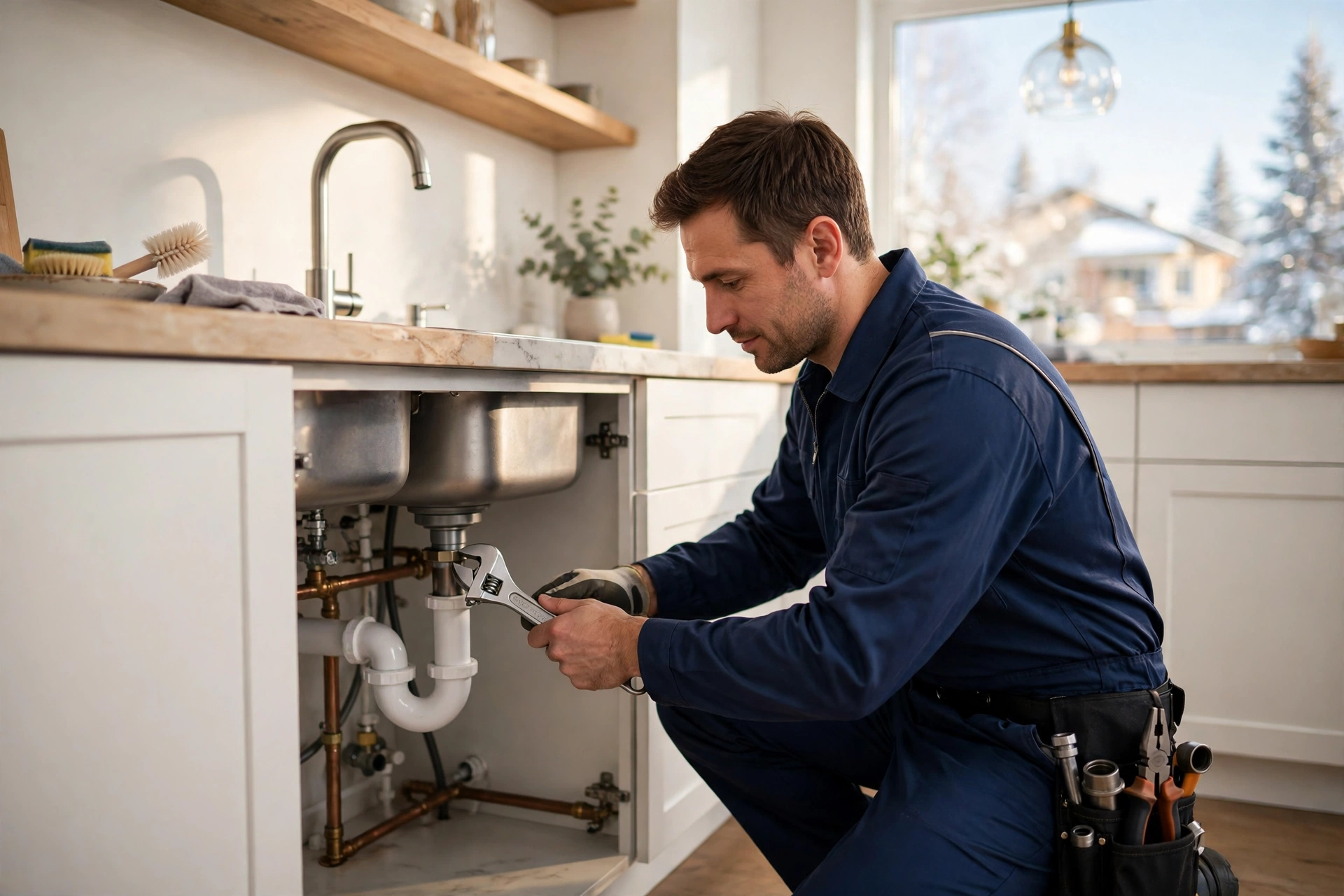
A burst pipe at 2 a.m. doesn’t wait for a referral. The homeowner grabs their phone, searches “emergency plumber near me,” and calls the first company that looks trustworthy. SEO for plumbers is the work of making sure your company is the one they find — in the map pack, in the organic results, and on pages that answer their panic in plain language.
This guide walks through what plumbing SEO looks like in practice for Canadian companies: the rankings that generate calls, the profile work that pays off fastest, and realistic timelines for the Canadian market.
Why Plumbers Win or Lose on Google Searches
Plumbing is the textbook example of search-driven demand. Nobody hires a plumber in advance — the need arrives suddenly (a leak, a flood, no hot water), and the customer searches with high intent and near-zero patience. Most click one of the first results they see, and very few scroll past the first page.
That behaviour makes organic search one of the most cost-effective lead channels a Canadian plumbing company can build. Unlike ads, where you pay for every click in perpetuity, the rankings you earn through SEO keep sending calls week after week. Over time, the cost per booked job from SEO typically drops well below paid channels — which is why growing plumbing companies treat SEO as a long-term asset rather than a monthly expense.
Plumbing searches split neatly into two kinds of demand, and your SEO should serve both. Emergency searches (“emergency plumber Vancouver,” “burst pipe repair Toronto”) are urgent, high-value, and decided in minutes. Planned searches (“water heater installation cost Calgary,” “bathroom rough-in Ottawa”) move slower but carry big-ticket jobs. Capture the emergency calls first — they’re the fastest wins — then build out the planned-work pages for steady revenue.
The Three Rankings That Matter for a Plumber
When a customer searches for a plumber, Google can show up to three types of results. You want to appear in all of them:
1. The Map Pack (Local Pack)
The three map listings under the map are prime real estate — especially on a phone, where most emergency searches happen. Ranking here depends on relevance (your services and categories), distance (how close you are to the searcher), and prominence (reviews, citations, and overall reputation).
2. The Organic Results
The classic blue-link results below the map. These reward in-depth, trustworthy pages about your services and your city — for example “Drain Cleaning Mississauga” or “Water Heater Installation Edmonton.”
3. The “People Also Ask” and AI Overviews
To get cited there, answer common questions clearly and directly — which is exactly what a stressed homeowner wants. A strong FAQ section on every service page serves both.
Your Google Business Profile: The Highest-ROI Plumbing SEO Task
For most plumbing companies, a well-optimized Google Business Profile (GBP) produces results faster than anything else on this list:
- Choose the right primary category. “Plumber” for most companies, with secondary categories like “Emergency Plumbing Service,” “Drainage Service,” or “Water Heater Repair Service” where accurate.
- Define your service areas. List the cities and neighbourhoods you cover so you show up across your whole territory.
- Complete every section. Services with descriptions (emergency repairs, drain cleaning, water heater install, sewer camera inspection, leak detection), hours, and a proper appointment or quote URL.
- Add 24/7 hours if you offer emergency service. Emergency searches happen at night and on holidays — your profile should reflect your real availability.
- Add real photos. Your vans, your technicians in uniform, before-and-after shots of real jobs. Photos reassure a homeowner who’s about to invite a stranger into their house.
- Post updates. Seasonal reminders (winterizing pipes, sump pump checks before spring melt), new services, holiday emergency hours.
- Answer every question in the Q&A section. Customers ask about response times, call-out fees, and service areas — seed these yourself with honest answers.
- Keep hours accurate, always. Wrong holiday hours are one of the fastest ways to lose trust — and a one-star review.
Learn more in our local SEO service overview — GBP management sits at its core.
Reviews: The Deciding Factor for Emergency Calls
Reviews do double duty in plumbing SEO. Google uses review volume and ratings as a map pack ranking signal, and customers use them as the deciding factor between two equally-ranked companies — especially for emergency work, where trust matters more than price. A 4.9-star company with 250 reviews wins the call over a 4.3 with 30, nearly every time.
Building a review engine doesn’t require anything fancy:
- Ask after every completed job. Train technicians to ask right after a clean, successful repair.
- Send a short text follow-up with a direct review link within 24 hours.
- Respond to every review, including negative ones, calmly and professionally.
- Never offer incentives for reviews — it violates Google’s policies and can get reviews removed.
The Service Pages Every Plumbing Website Needs
Your homepage can rank for “plumber + [your city]” — but the real call volume lives in problem-specific searches: “clogged drain Vancouver,” “water heater replacement cost Toronto,” “sewer backup cleanup Calgary.” You capture these with dedicated service pages, one per service:
- Emergency plumbing
- Drain cleaning and unclogging
- Water heater installation and repair (tank and tankless)
- Leak detection and pipe repair
- Sewer line inspection and repair
- Fixture installation (taps, toilets, showers)
- Backflow testing and prevention
- Plumbing for renovations and new builds
Each page should answer the homeowner’s real questions: what the service includes, typical price ranges in CAD, how fast you respond, and which neighbourhoods you serve — plus what to do right now before you arrive (turn off the main valve, shut off the water heater). Pages that solve the customer’s immediate problem rank — and convert — better than generic service lists.
Seasonal and Problem-Based Content: Owning Demand Year-Round
Plumbing demand follows the Canadian seasons, and content lets you own each wave — one genuinely useful guide per season:
- Winter (November–March): frozen and burst pipes, no hot water. Guides on preventing frozen pipes and what to do when pipes burst capture both emergency and prevention searches.
- Spring (April–May): sump pump checks, foundation leaks from snowmelt, outdoor faucet repairs — searched for before they become emergencies.
- Summer: irrigation, sewer odours, renovation season. Renovation plumbing guides attract high-value planned projects.
- Fall (September–October): winterizing checklists and water heater tune-ups — “is your plumbing ready for winter” content.
A simple seasonal calendar — one genuinely useful guide per season — gives your site fresh relevance signals and earns links from local media at exactly the moments journalists write about burst pipes and floods.
Technical Basics Most Plumbing Sites Miss
Plumbing company websites are often built cheap and rarely maintained. The fixes that matter:
- Mobile speed first. Emergency searchers are on phones, often on poor connections. If your site takes more than a few seconds to load, they call the next result.
- Click-to-call everywhere. A tap-to-call button fixed on mobile screens is a conversion feature, not a decoration.
- LocalBusiness schema. Structured data telling Google your name, phone, hours, and service area supports map pack visibility and rich results.
- One H1 per page, descriptive titles. “Emergency Plumber in Vancouver | 24/7 Service | [Company Name]” tells Google and the customer everything in one line.
- HTTPS and a working contact form. Still missing on more plumbing sites than you’d expect — and customers notice the “not secure” warning.
Realistic Timelines: How Long Before the Calls Start?
Honest answer: it depends on your market and your starting point, but plumbing SEO follows a predictable pattern. Map pack improvements from a properly optimized profile and a steady review flow can show results within the first one to three months — especially for emergency terms in less competitive suburbs. Organic rankings for competitive terms in big cities (Toronto, Vancouver, Calgary) typically take four to eight months of consistent work.
What shortens the timeline: a fast mobile site, genuine reviews arriving weekly, complete service pages, and accurate service-area coverage. What lengthens it: a brand-new domain, inconsistent business listings, and thin content copied from competitors. Any agency that promises page one in 30 days is selling you something you shouldn’t buy.
Frequently Asked Questions
How much does SEO cost for a plumbing company in Canada?
Most Canadian plumbing SEO programs run in the low-to-mid four figures per month in CAD, depending on your market’s competitiveness and how much content and link-building the program includes. A single-city company in a smaller market typically needs less than a multi-city operation competing in Toronto or Vancouver.
Is SEO or Google Ads better for plumbers?
Both have a role. Google Ads can generate emergency calls immediately, while SEO builds a compounding, lower-cost call stream over time. Most growing companies run ads for short-term volume while investing in SEO to reduce their long-term cost per booked job.
How do plumbers get more Google reviews?
Ask consistently at the right moment — right after a successful job — and follow up with a direct review link by text within 24 hours. Respond to every review, including negative ones. Steady, recent reviews matter more than a one-time burst.
Can a new plumbing company outrank established competitors on Google?
Yes, especially in the map pack and for specific services. Established companies often have neglected profiles and thin websites. A new company with a complete Google Business Profile, strong reviews, and genuinely useful service pages can compete within months.
What is the most important SEO factor for plumbers?
For most plumbing companies, it’s the combination of a fully optimized Google Business Profile and a strong review profile. Those two drive map pack visibility, which captures the majority of “plumber near me” searches — the searches with the highest call intent, especially for emergencies.
Get More Emergency Calls From Google
When the next burst pipe happens in your city, your company should be the one that gets the call. If you’re invisible on Google — or visible but not converting — let’s fix that. Call +1 (888) 884-6556, email hello@dcmarketing.ca, or request a free consultation and we’ll show you exactly where your company stands and what it will take to rank.